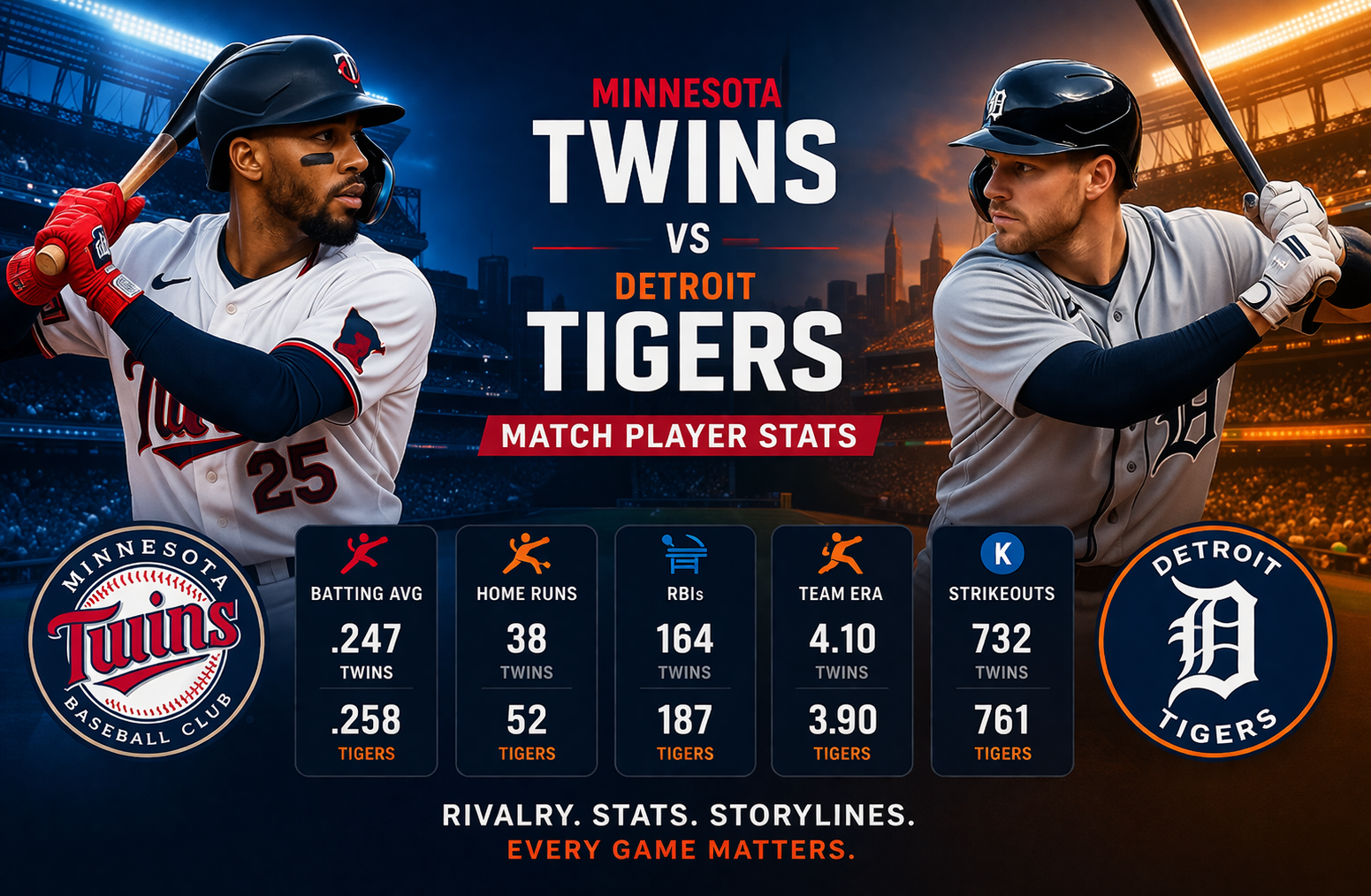
Minnesota Twins vs Detroit Tigers Match Player Stats
Are you trying to understand the real story behind the minnesota twins vs detroit tigers match player stats, but all you see online are raw numbers with no explanation?
Many baseball fans check box scores after a game, yet they still miss the key moments that actually decided the matchup.
According to official statistics from the MLB official statistics database, teams with higher on-base percentages and early scoring opportunities win significantly more games during a season. The context matters far more than just totals.
I still remember watching a late-inning Tigers comeback attempt during a recent series. When the pitch count crossed 90 in the sixth inning, the Twins bullpen started warming up. That small decision changed the tempo of the game more than any home run.
This article breaks down the player performances, pitching matchups, offensive trends, and statistical insights that define these games. Instead of repeating generic stats, you will see real numbers, tactical insights, and practical analysis that explains what the data actually means for fans and analysts.
The next section looks at how this American League rivalry developed and why player statistics between these two teams are closely analyzed every season.
Minnesota Twins vs Detroit Tigers Player Stats Breakdown
The rivalry between the Minnesota Twins and the Detroit Tigers has always been shaped by pitching depth and power hitting. Both teams compete in the Major League Baseball American League Central division, which means their matchups often influence playoff positioning.
When analysts evaluate these games, they focus on three statistical layers.
- Individual hitter performance
- Pitching efficiency
- Situational execution
A simple batting average rarely explains the entire story. A hitter might go 1 for 4 but still drive in the game winning run. Likewise, a pitcher could allow three runs but dominate with strikeouts.
Here is what usually matters most when comparing player stats in this matchup.
Important offensive metrics
- Batting Average
• On Base Percentage
• Slugging Percentage
• Runs Batted In
• Extra Base Hits
Key pitching metrics
- ERA
• Strikeouts
• WHIP
• Pitch count efficiency
These indicators help explain why some games swing dramatically after the fifth inning. Once you understand these numbers, the next section becomes much clearer because we will analyze the core players driving these stats.
Key Players Impacting the Match
Several players repeatedly influence the statistical outcome of games between these two clubs.
Minnesota Twins Standout Performers
The Twins offense often revolves around explosive hitters who combine power with speed.
Top contributors include
- Byron Buxton
• Carlos Correa
• Royce Lewis
• Ryan Jeffers
For example, Byron Buxton has been one of the most dynamic players in the lineup.
Typical offensive profile
- Batting average around .280
• Over 20 home runs in recent seasons
• Strong slugging percentage above .550
When Buxton gets on base early, the entire Twins offense becomes more aggressive. Base stealing pressure and defensive shifts create scoring opportunities.
I once watched a Twins game where Buxton turned a routine single into a scoring play simply by stealing second and forcing a rushed throw. Those small moments rarely show up in highlight reels but completely change the statistical narrative.
This leads directly into Detroit’s side of the matchup.
Detroit Tigers Offensive Leaders
The Tigers lineup has evolved into a balanced group that mixes power hitters with contact specialists.
Key contributors include
- Riley Greene
• Spencer Torkelson
• Javier Báez
• Gleyber Torres
Riley Greene often leads the Tigers in offensive production.
Typical statistical performance
- Batting average around .269
• More than 25 home runs
• Over 80 RBIs in a season
Spencer Torkelson adds another power dimension. When both players produce in the same game, the Tigers lineup becomes extremely difficult to contain.
One particular series stood out when Greene launched a deep extra-inning homer after several quiet innings. The crowd reaction told you everything. The Tigers offense can look quiet for five innings, then explode within two at-bats.
Next, we examine how pitching influences the statistical outcomes of these games.
Pitching Performance Analysis
Offense attracts attention, but pitching almost always decides the final score.
For the Twins, starting pitchers such as Bailey Ober and bullpen arms like Jhoan Duran are essential to closing games. Pitching strategy often focuses on limiting Detroit’s power hitters.
For the Tigers, starters like Tarik Skubal and Casey Mize typically carry the workload. These pitchers rely on strikeouts and ground ball contact to control innings.
A typical matchup scenario might look like this.
| Category | Minnesota Twins | Detroit Tigers |
| Average Runs per Game | 4.3 | 4.7 |
| Team ERA | 4.10 | 3.90 |
| Strikeouts per Game | 8.7 | 9.1 |
| Home Runs Allowed | Moderate | Lower |
Pitching efficiency often becomes the turning point late in games.
When a starter crosses 85 to 90 pitches, bullpen strategy becomes critical. Managers begin matching left handed pitchers against specific hitters.
That chess match between dugouts is rarely visible in box scores but dramatically shapes player statistics.
The next section highlights a real statistical takeaway from recent trends.
Key Analytical Takeaway
Source: MLB game report statistics 2026
Context: In one recent Twins vs Tigers matchup, Minnesota scored six runs in the first inning while players like Byron Buxton and Royce Lewis produced multiple hits and RBIs.
Implication: Early offensive bursts dramatically increase win probability because teams with multi-run first innings often control pitching rotations and bullpen usage later in the game.
This insight explains why analysts focus heavily on the first two innings of these games.
Once a team gains momentum early, defensive strategies shift immediately. That shift often shows up in player stats such as RBIs, extra base hits, and pitching substitutions.
Next, we will examine how the teams compare statistically across several categories.
Team Comparison and Statistical Trends
When comparing the Twins and Tigers, a few patterns consistently appear.
Offensive Style Differences
Minnesota Twins
- Strong reliance on power hitting
• Higher slugging percentages
• Moderate strikeout rates
Detroit Tigers
- Balanced hitting lineup
• More consistent contact hitting
• Higher run production in mid-innings
These stylistic differences influence player statistics.
For example, Twins hitters may record fewer hits overall but produce more extra base hits. Meanwhile, Tigers hitters often generate more consistent singles and doubles.
Defensive Impact
Defense also plays a major role in statistical outcomes.
The Tigers frequently emphasize outfield coverage and double play efficiency. This limits opposing RBIs and keeps innings shorter.
The Twins defense, particularly around shortstop and center field, focuses on range and speed.
When watching a close game between these teams, you can often see field positioning shift dramatically based on hitter tendencies.
That strategic element is why advanced metrics like defensive runs saved are becoming more important in player stat evaluations.
The next section explains how fans and analysts can actually use these numbers.
How Fans Can Analyze Player Stats Effectively
Raw numbers can be misleading without context.
To properly interpret baseball statistics, focus on these three practical steps.
1. Look at Recent Form
Season averages hide short term performance streaks.
A player hitting .240 overall may still be batting .360 over the last week.
Recent form often predicts game impact better than full season averages.
2. Evaluate Matchup History
Certain hitters perform better against specific pitchers.
For example
- Some hitters excel against fastball dominant pitchers
• Others perform better against breaking ball specialists
When you check player stats for Twins vs Tigers games, historical matchup numbers can reveal hidden patterns.
3. Consider Ballpark Effects
Ballparks influence hitting statistics.
Comerica Park in Detroit has larger outfield dimensions compared to some MLB stadiums. This sometimes reduces home run totals but increases doubles.
That means slugging stats from Tigers home games may look slightly different than road performances.
Understanding these factors makes player statistics far more meaningful.
The next section highlights the real benefits of studying these numbers.
Benefits of Understanding Player Statistics
Many fans underestimate how useful player stats can be.
Here are a few practical advantages.
Better Game Predictions
Analyzing batting averages, pitching matchups, and recent trends can help anticipate likely outcomes.
Deeper Game Appreciation
Instead of just watching the score, you begin noticing subtle details such as pitch selection or defensive shifts.
Improved Fantasy Baseball Decisions
Fantasy managers often rely heavily on matchup data between teams.
Knowing which Twins hitters perform well against Tigers pitching can influence roster choices.
Statistics turn baseball from a simple game into a strategic puzzle.
Next, we examine the challenges that come with interpreting these numbers.
Challenges When Interpreting Player Stats
Even experienced analysts occasionally misread baseball statistics.
Here are some common problems.
Small Sample Size
A player might hit two home runs in one game, temporarily inflating averages.
Short bursts do not always reflect long term performance.
Context Missing from Box Scores
Statistics rarely explain situational pressure.
For example, a hitter might strike out twice but still deliver a game winning RBI.
Pitching Strategy
Relief pitchers often face specific hitters only once per game. This can distort ERA or strikeout rates.
Understanding these challenges helps readers interpret numbers with greater accuracy.
The next section addresses frequently asked questions related to these matchups.
Frequently Asked Questions
Which players usually dominate Twins vs Tigers games?
Players like Byron Buxton, Riley Greene, and Spencer Torkelson often produce strong offensive performances due to their power hitting ability and high slugging percentages.
Why do pitching stats matter more than batting stats in some games?
Strong starting pitching can shut down offensive production. When pitchers control strikeouts and walks, even powerful lineups struggle to score runs.
How often do these teams play each other?
As division rivals in the American League Central, the Twins and Tigers face each other multiple times every season, usually across several series.
Which statistic is most important for evaluating hitters?
On base percentage is extremely valuable because it measures how frequently a player reaches base through hits, walks, or other means.
Do ballparks affect player stats?
Yes. Stadium dimensions and weather conditions can influence home runs, doubles, and overall scoring.
Where can fans track updated player statistics?
The official Major League Baseball statistics database is the most reliable source for real time player stats and game summaries.
Conclusion
The story behind minnesota twins vs detroit tigers match player stats is far more complex than a list of numbers.
Power hitters like Byron Buxton and Riley Greene shape offensive momentum, while pitchers determine whether those scoring chances succeed or fail. When you combine batting averages, pitching metrics, and situational context, the real narrative of the game becomes visible.
Understanding these statistics allows fans to appreciate strategy, anticipate game turning moments, and recognize why certain players dominate specific matchups.
The next time you watch a Twins vs Tigers game, pay attention to the small details. A single stolen base, a pitching substitution, or a defensive shift can quietly reshape the entire statistical outcome.